A few weeks ago I had a conversation with Deepak Tripathi, who leads a Global Capability Center. The role gives him a cross-sectional view of how work is organized across functions, seniority levels, and operational contexts that is genuinely hard to get from a single vantage point. Several of my assumptions about how organizations develop capability did not survive the conversation intact. This is an attempt to work through what the research actually says about where AI is putting the pressure, and why it matters.
The most useful framing here is not that AI "replaces jobs." The more defensible claim, and the one that holds up across the research, is that AI changes the composition of tasks inside jobs. The ILO's analysis of generative AI argues that it is more likely to automate some tasks within occupations while augmenting others than to fully eliminate entire occupations. Stanford research finds that workers broadly want AI to handle repetitive tasks while retaining human oversight and agency in judgment-heavy work. These are not the same as the headline versions of this debate.
From skill-biased change to something more specific
The concept of skill-biased technological change has been the standard lens for understanding how technology reshapes labor markets. The basic idea is that technology increases demand for advanced cognitive and analytical work while reducing demand for routine tasks. That framework has been useful, but it is broad enough to obscure what is actually happening with AI.
More recent research suggests the pressure point may be more specific: seniority, not just skill. A 2025 study titled Generative AI as Seniority-Biased Technological Change examines U.S. resume and job-posting data and finds that AI adoption is associated with reduced junior employment in adopting firms, driven mainly by slower hiring, while senior employment continues to grow. The issue is not that AI is targeting the most complex work. It is that AI is absorbing the kind of structured, bounded work that has historically been how early-career workers get their start.
That is a more uncomfortable finding than the general "AI upgrades skill demands" narrative. It means the pressure point is not distributed evenly across career levels. It concentrates at the entry points.
Why the pyramid is under pressure
A traditional organizational structure looks like a pyramid. A wide base of execution-heavy roles supports a narrower set of more strategic responsibilities at the top. This shape made sense when routine coordination, monitoring, and first-pass analysis all required large human teams to run. The base was both a work engine and a training mechanism. People learned by doing the lower-level work before moving up.
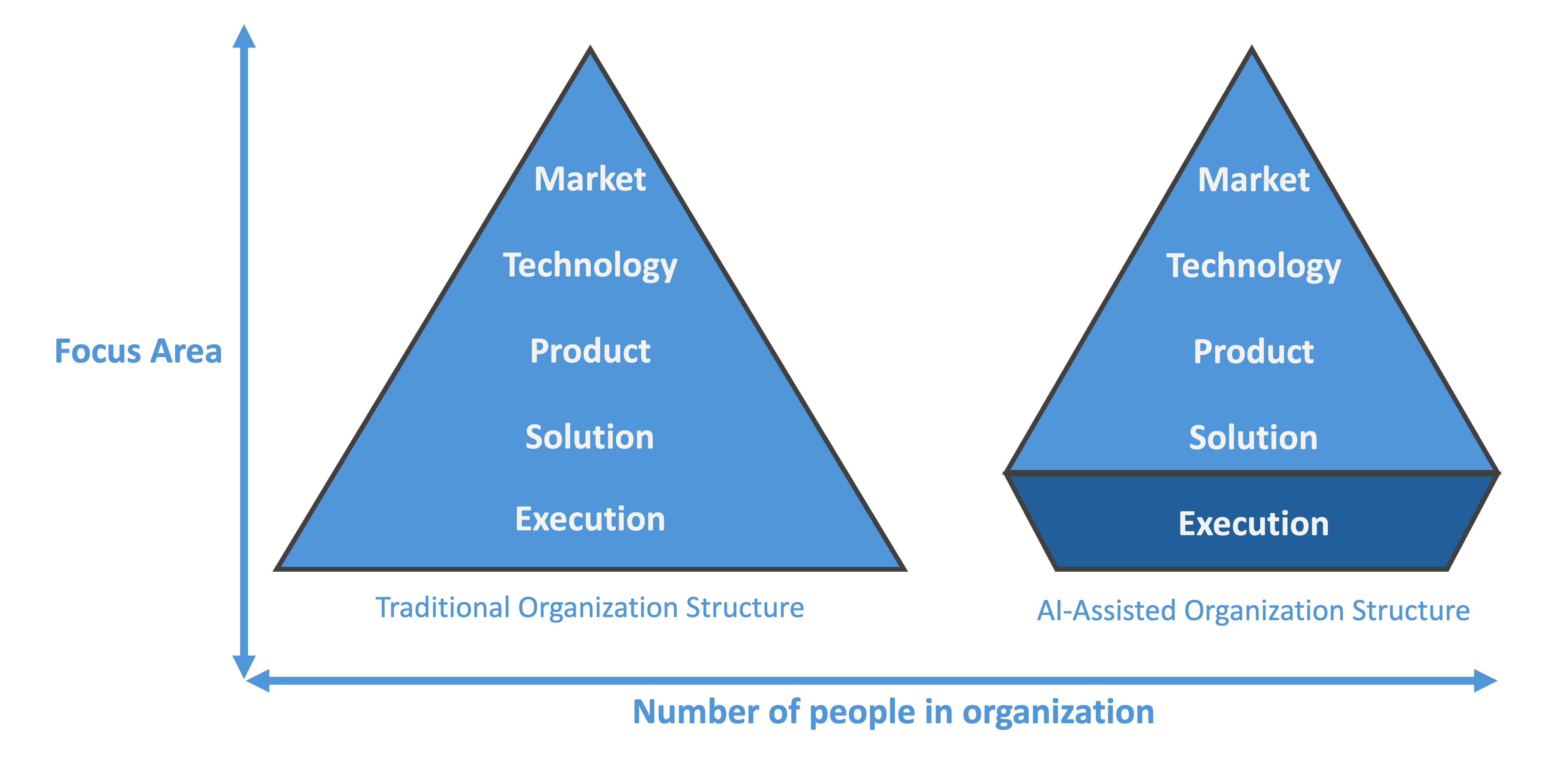
AI systems are increasingly capable of handling exactly the kind of structured work that populates the base of that pyramid: tasks that are repetitive, rule-based, and easy to standardize. The consequence is not simply fewer roles at the bottom. It is a reconfiguration of how workers move upward, how apprentices learn, and how organizations develop the people who will eventually fill senior positions. If the base shrinks, the pipeline that feeds the rest of the structure changes with it.
A more useful way to describe capability
The "high-skill versus low-skill" framing flattens something that is better described as a continuum. Most professionals operate across multiple modes simultaneously, and the categories shift as careers develop. A more granular way to think about it:
- Execution-oriented work: routine tasks with limited ambiguity.
- Solution-oriented work: handling defined problems and exceptions.
- Product-oriented work: connecting work to user value and lifecycle outcomes.
- Technology-oriented work: improving systems, automation, and tools.
- Market-oriented work: understanding customer needs, business constraints, and strategic positioning.
Newer workers typically start with more execution-heavy responsibilities before expanding into judgment-based work. Research on labor polarization supports the idea that routine work is more exposed to automation, while non-routine analytical and interpersonal work remains more resilient. That is consistent with what is showing up in the seniority-biased data: the exposure concentrates at the execution end of the continuum, which happens to be where early careers begin.
The SOC example
Security Operations Centers illustrate the dynamic concretely. A typical SOC is structured in tiers: Tier 1 handles alert monitoring, triage, and first-pass investigation; Tier 2 handles deeper analysis and incident response; Tier 3 focuses on advanced threat hunting and engineering. The lower tier is the most repetitive and the most standardized, which makes it the most exposed to automation.
As AI improves, a meaningful share of Tier 1 work becomes automatable through alert classification, enrichment, summarization, and response orchestration. That does not eliminate the need for human operators. But it does reduce the volume of purely manual work available at the entry level. In practice, entry paths into cybersecurity are already beginning to shift toward automation engineering, detection tuning, and more analytical responsibilities earlier than they would have five years ago. The job still exists. The shape of how you enter it is changing.
What the research actually shows
The WEF's Future of Jobs Report 2025 projects that AI and big data will be among the fastest-growing skill areas over the next several years, and that a large share of workers will need reskilling by 2030. Goldman Sachs has argued that AI can automate a meaningful share of work hours and will likely displace some roles during the transition while creating demand for AI-related and specialized work.
At the same time, the disruption is not showing up cleanly in labor market data yet. The Yale Budget Lab finds that the broader labor market has not yet shown clear AI-driven disruption at scale. MIT Sloan's review of recent research similarly emphasizes that AI affects specific tasks within jobs rather than whole occupations, and that the employment effect depends heavily on whether AI replaces routine tasks or amplifies expert work.
The honest read is that the directional change is real even if the pace is uncertain. The pyramid is under pressure. The base is contracting relative to the rest. And the effect is concentrating on the people who were going to enter at that base.
What this actually means
The more defensible conclusion is not that entry-level work disappears. It is that the share of work that is purely entry-level in nature shrinks. The labor market will increasingly reward workers who can move quickly from execution to interpretation, from routine processing to automation, and from task completion to systems thinking.
For organizations, that means entry-level roles need redesigning. The "do the boring work first and learn from it" model of career development is going to be less reliable when AI handles a growing share of the boring work. Organizations will need to be more deliberate about how they build the judgment and contextual understanding that used to develop organically through years of repetitive work.
For individuals, the path that made sense in 2015 looks different from the one that makes sense now. Competing with AI on repetitive, bounded tasks is a losing bet. Learning how to use AI, improving workflows, and building capabilities that sit higher up the value chain is not optional upskilling. It is the actual job.
That is the real challenge of the AI era, and it is more structural than most of the conversation about it suggests.
References: Goldman Sachs · MIT Sloan · Stanford HAI · Yale Budget Lab · WEF Future of Jobs 2025 · ILO Generative AI and Jobs · Seniority-Biased Technological Change · NBER Skill-Biased Change